Hair Transplant Surgeon in Gurgaon: Consultation, Planning & Realistic Outcomes
A practical guide to what actually happens before, during, and after a hair transplant with Dr Gaurav Solanki at Cult Aesthetics, Sector 46, Gurgaon.
A hair transplant moves your own hair follicles from a donor area — usually the back and sides of the scalp — to areas of thinning or baldness. In Gurgaon, patients typically begin with a consultation for hair-loss grading and donor evaluation, followed by a personalised hairline design, the surgical session itself (FUE or DHI, usually completed in one day), and a recovery period spanning several months for full results to show. Suitability, technique, and graft count depend entirely on individual consultation — this page explains that process in detail.
Is a hair transplant consultation right for you?
Not everyone experiencing hair loss needs surgery, and not everyone who wants surgery is a suitable candidate yet. A consultation exists to answer that question honestly before anything else.
Stable Pattern Hair Loss
Men and women with hair loss that has plateaued — rather than actively progressing month to month — are generally the strongest surgical candidates.
Visible Thinning or Recession
Receding hairlines, crown thinning, or diffuse density loss that affects confidence or styling options are common reasons patients seek an opinion.
Prior Non-Surgical Treatment
Patients who have tried medical therapy and want to understand whether surgical restoration is now a reasonable next step.
Second Opinions & Corrective Cases
Patients unhappy with a previous transplant elsewhere, seeking an honest assessment of what can realistically be improved.
What happens in a consultation with Dr Gaurav Solanki
The consultation is a clinical assessment, not a sales conversation. It is designed to answer one question honestly: is surgery the right option for you, and if so, what should it look like?
Hair-Loss Grading
The scalp is examined and hair loss is graded using recognised classification patterns, establishing a clear starting point for any plan.
Donor-Area Evaluation
Donor density, scalp laxity, and hair calibre are assessed to determine how many grafts can safely be harvested without compromising long-term donor supply.
Candidacy Discussion
Dr Solanki discusses whether surgery, medical management, or a combined plan is appropriate — including telling patients directly when surgery is not yet advisable.
Hairline & Density Planning
If surgery is appropriate, a hairline is proposed and discussed with the patient, along with a graft-count estimate justified zone by zone.
Technique & Cost Explanation
FUE and DHI are explained in plain terms, along with how technique choice and graft count affect overall cost.
Hairline planning and donor evaluation, explained
Hairline Planning
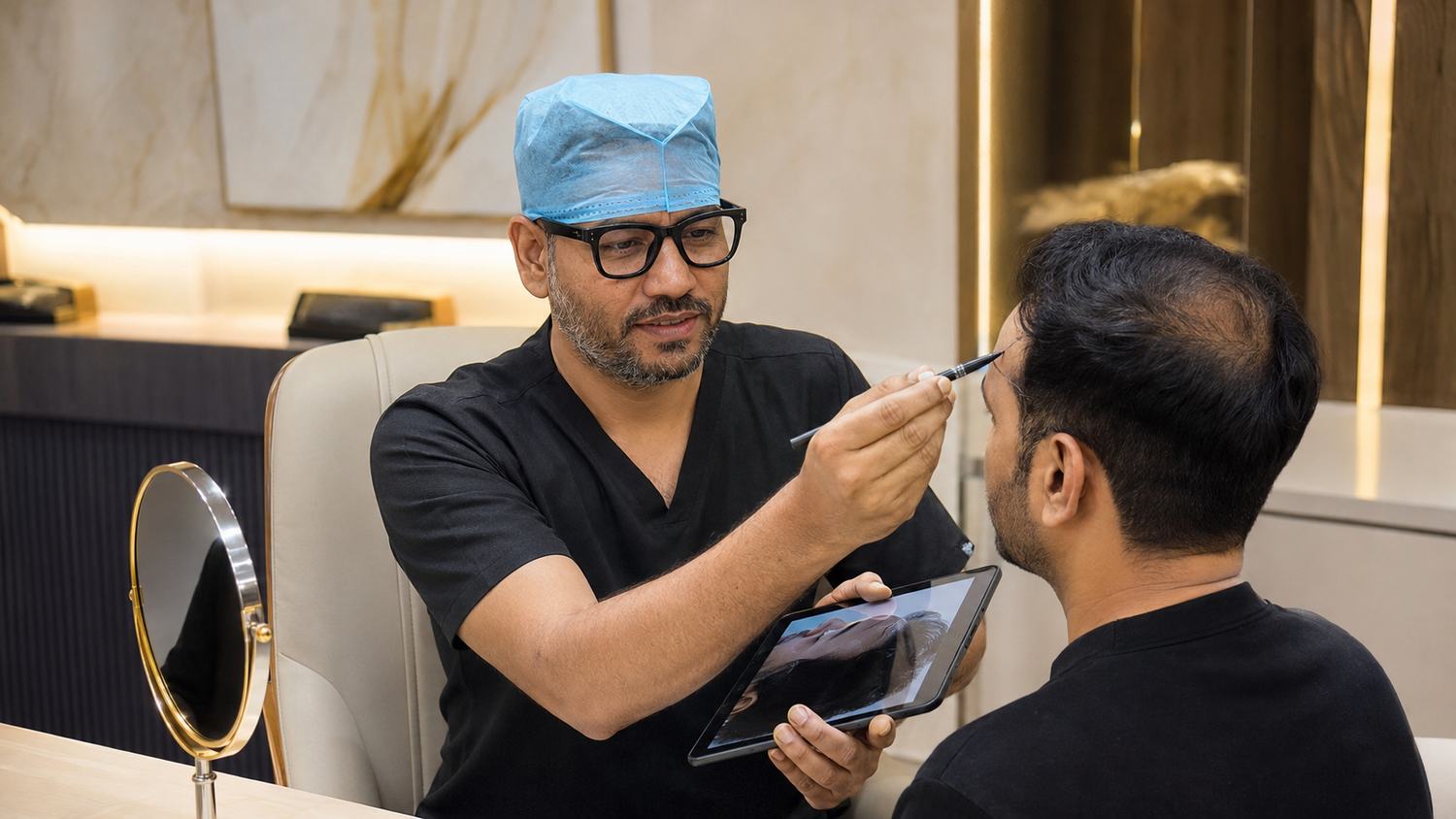
A natural hairline is not a straight line — it is irregular at the leading edge, uses finer single-hair grafts along the front row, and is positioned according to your age, facial proportions, and expected pattern of future loss. Designing it too low, too dense, or too young for your face is one of the most common causes of an unnatural-looking result. Dr Solanki draws the proposed hairline with the patient present, so it can be reviewed and adjusted before any grafts are placed.
Age-appropriate design also means accounting for hair loss that may continue in untreated areas. A hairline planned in isolation, without regard to the rest of the scalp’s future pattern, can look disconnected from surrounding hair years later.
Donor Evaluation
The donor area — typically the back and sides of the scalp — is genetically more resistant to pattern hair loss, which is why grafts taken from it can continue growing after transplantation. But it is a limited resource: it does not regenerate density that has been extracted.
Evaluation includes donor density (grafts per square centimetre), scalp laxity (how easily skin can be excised or punched), and hair shaft calibre, all of which determine a safe maximum graft count — a number that protects both today’s result and any future session that may be needed.
What a hair transplant can and cannot do
Setting realistic expectations before surgery is part of responsible planning, not a disclaimer added afterward.
Density Is Relative
Transplanted density is designed to look full within the limits of available donor supply — it is not the same as pre-loss density in most cases.
Growth Takes Time
Final results are typically assessed around 10 to 12 months after surgery, not in the weeks immediately following.
Native Hair May Continue Thinning
Surrounding non-transplanted hair can keep thinning with age, which is why medical management is often discussed alongside surgery.
Results Vary By Case
Donor quality, hair-loss grade, scalp characteristics, and post-operative care all influence the outcome — results vary from person to person.
What to expect after the procedure
Recovery is gradual and follows a broadly predictable pattern, though timing can vary by individual.
Mild scalp tightness and tiny scabbing around grafts, generally settling within the first several days.
Transplanted hair shafts typically shed while roots remain in place — an expected and temporary phase, not a sign of failure.
New growth usually begins from the transplanted roots, appearing fine and gradually thickening.
Density and texture continue to mature, with results typically assessed toward the end of this window.
Why doctor-led planning changes the outcome
In many high-volume clinics, the consultation, hairline design, and even parts of the surgery are handled by technicians, with the surgeon involved only briefly. At Cult Aesthetics, Dr Gaurav Solanki personally examines every patient, designs every hairline, and leads every surgical session.
This matters because hairline design and donor evaluation are judgment calls, not standardised templates — they depend on facial structure, hair-loss trajectory, and donor biology that vary from patient to patient. A surgeon who has personally assessed 800+ documented cases over 12+ years brings that judgment to your specific case, rather than applying a generic plan.
Common questions before a first consultation
How should I choose the best hair transplant surgeon in Gurgaon?
Patients asking this question are usually better served by criteria than by rankings: look for doctor-led consultation and hairline design, transparent donor-area evaluation, honest candidacy assessment (including being told when you are not a candidate), documented case experience, and clear technique and cost explanations — rather than choosing on price per graft alone.
What is the difference between FUE and DHI?
Both are follicular unit techniques that extract individual grafts from the donor area rather than a linear strip. FUE extracts grafts and implants them via manually made incisions; DHI uses a specialised implanter pen to place each graft directly without pre-made incisions. Which is appropriate depends on graft count, hair characteristics, and the areas being treated — this is discussed during consultation.
How many grafts will I need?
There is no fixed number — graft count depends on the area of thinning, hair-loss grade, and desired density, balanced against what your donor area can safely supply. This is determined only after donor evaluation in consultation, not estimated over the phone.
At what age can someone get a hair transplant?
There is no single fixed age. What matters more is whether hair loss has stabilised enough to plan a hairline that will still look proportionate as loss potentially continues. This is why age-appropriate planning, not just current appearance, is part of every consultation.
Is a hair transplant a one-time procedure?
Many patients need only one session, but some individuals with progressive hair loss may consider a second session years later to address new thinning. Whether this applies to you depends on your hair-loss pattern and how much donor area was conserved in the original plan.
Start with an honest consultation
Bring your questions. Dr Solanki will examine your scalp, evaluate your donor area, and tell you plainly what is realistic for your case.
Not sure where to start?
WhatsApp a photo of your scalp — Dr Gaurav reviews it personally. No cost, no obligation.
WhatsApp a Photo Prefer to call? 9990449555