Our Approach: How Dr Gaurav Solanki Plans a Hair Transplant Result
The technical steps of a hair transplant are broadly similar across clinics. What differs is the thinking behind each decision — and that thinking is what this page explains.
Dr Gaurav Solanki’s approach to hair restoration rests on five principles: natural hairline design suited to your face and age, donor-area safety that protects your future options, realistic density planning based on what your donor area can actually supply, patient education so decisions are informed rather than assumed, and transparent expectations set before surgery, not managed after it. Results vary from person to person, and suitability for any specific plan depends on individual consultation.
What guides every case at Cult Aesthetics
These are not marketing promises — they are the working principles Dr Solanki applies during consultation, planning, and surgery.
Natural Hairline Design
A hairline is designed, not copied. It follows an irregular leading edge, uses finer single-hair grafts at the front row, and gradates in density toward the mid-scalp — mirroring how hair naturally grows rather than presenting a dense, uniform wall of hair.
Age-Appropriate Planning
A hairline that suits a patient today can look out of place in a decade if future hair loss isn’t accounted for. Planning considers where a patient’s hair loss is likely headed, not only where it stands on the day of consultation.
Donor Safety
The donor area cannot be replenished once depleted. Extraction patterns are planned to avoid over-harvesting any single zone, preserving both the cosmetic appearance of the donor area and the option of a future session if it is ever needed.
Realistic Density
Graft counts and density targets are set according to what the donor area can safely provide — not an idealised number chosen to impress at consultation. Patients are shown what density is achievable for their specific case before committing.
Long-Term Thinking
A plan is evaluated not just for how it looks on day one, but how it holds up as native hair around it continues to age and, in some cases, thin further over the following years.
Informed decisions, not assumed consent
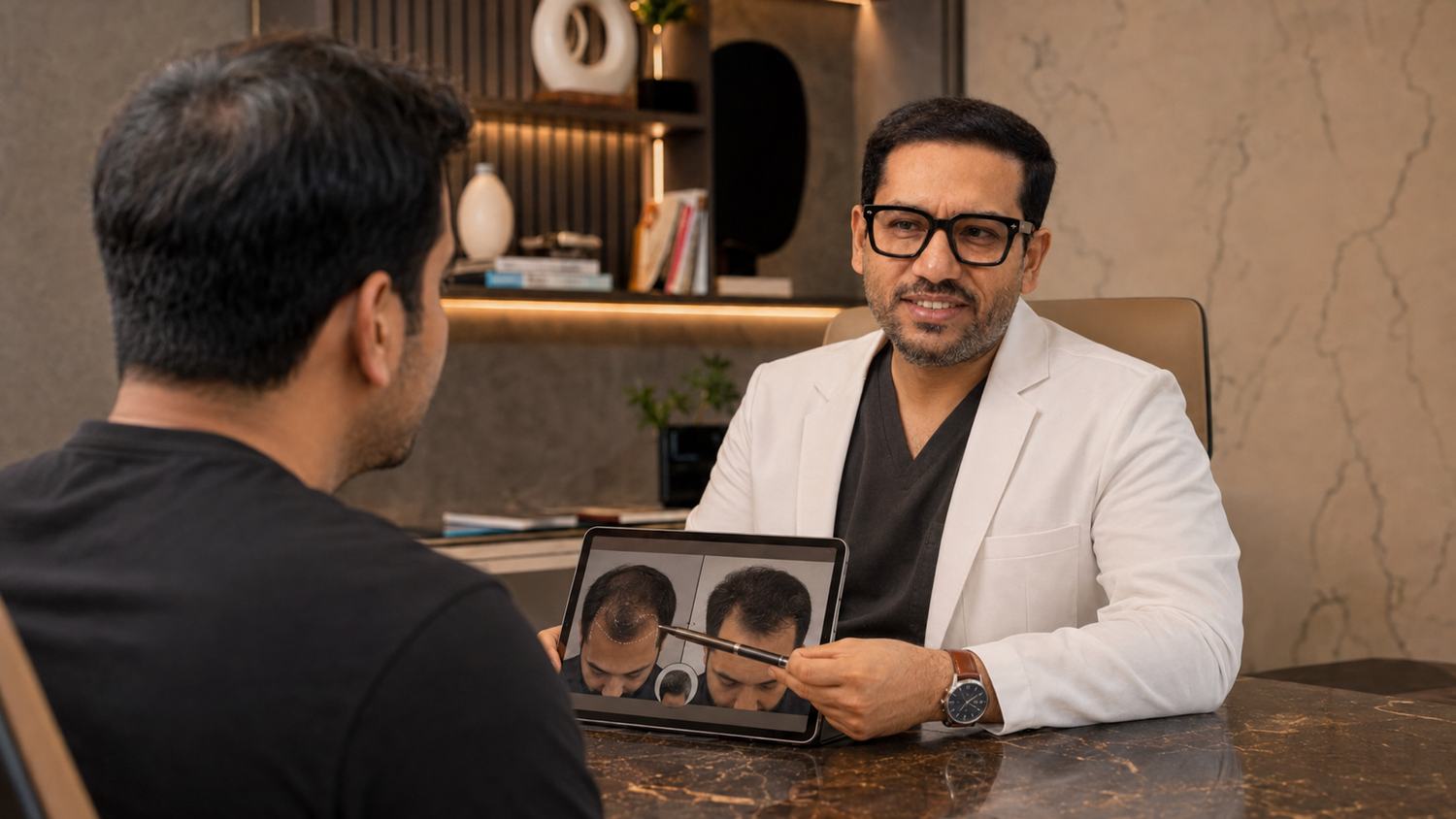
Every consultation includes an explanation of hair-loss grading, donor evaluation findings, and the reasoning behind the proposed hairline and graft count — not just the final numbers. Patients are encouraged to ask why a particular density or technique is being recommended for their case.
This extends to setting expectations about timeline. Patients are told, in advance, about the shedding phase that typically occurs in weeks 2 to 4 after surgery, so it is understood as expected biology rather than mistaken for a problem.
Transparent expectations also mean being clear about what a transplant does not do: it does not stop native hair loss elsewhere on the scalp, which is why medical hair-fall management is often discussed as part of a complete plan.
Expectations worth naming clearly
Part of transparent planning is being upfront about what surgery involves and what it doesn’t guarantee.
Recovery involves a real healing process
Scalp tenderness, tiny scabbing, and a temporary shedding phase are a normal part of recovery, not signs that something has gone wrong.
Density has a ceiling set by biology
No technique can create more hair than a patient’s donor area genuinely supports — planning works within that ceiling, not around it.
Results take the better part of a year
Meaningful assessment of a result is typically made around 10 to 12 months after surgery, once growth has matured.
Suitability is decided in consultation, not online
Photos and descriptions can suggest a starting point, but candidacy, technique, and graft planning are only ever confirmed in person.
“A good result is one that still looks right ten years from now — not just in the photo taken on day one.”
See how this approach applies to your case
Every plan starts with an honest, individual assessment. Book a consultation to find out what’s realistic for you.
Not sure where to start?
WhatsApp a photo of your scalp — Dr Gaurav reviews it personally. No cost, no obligation.
WhatsApp a Photo Prefer to call? 9990449555